
AI Infrastructure Investment Enters a New Phase
 Vortixel
14 minutes read
Vortixel
14 minutes read
For most of the artificial intelligence boom, the market had a relatively simple way of telling the story.
More powerful models needed more chips. More chips required more data centers. More data centers meant higher spending. And as long as demand for AI continued climbing, nearly every company positioned somewhere along that chain had a convincing growth narrative.
That story is becoming more complicated.
The latest market reaction to AI infrastructure companies shows that investors are still willing to reward businesses exposed to the buildout. CoreWeave and Super Micro Computer recently surged after stronger outlooks reinforced expectations that demand for AI computing capacity remains intense. CoreWeave’s revenue backlog reached $104.2 billion in the second quarter, while its forecast pointed toward higher revenue, operating profit, and capital spending.
But beneath those bullish moves, something more important is changing.
AI infrastructure is no longer simply a technology investment cycle.
It is becoming a capital-market system of its own.
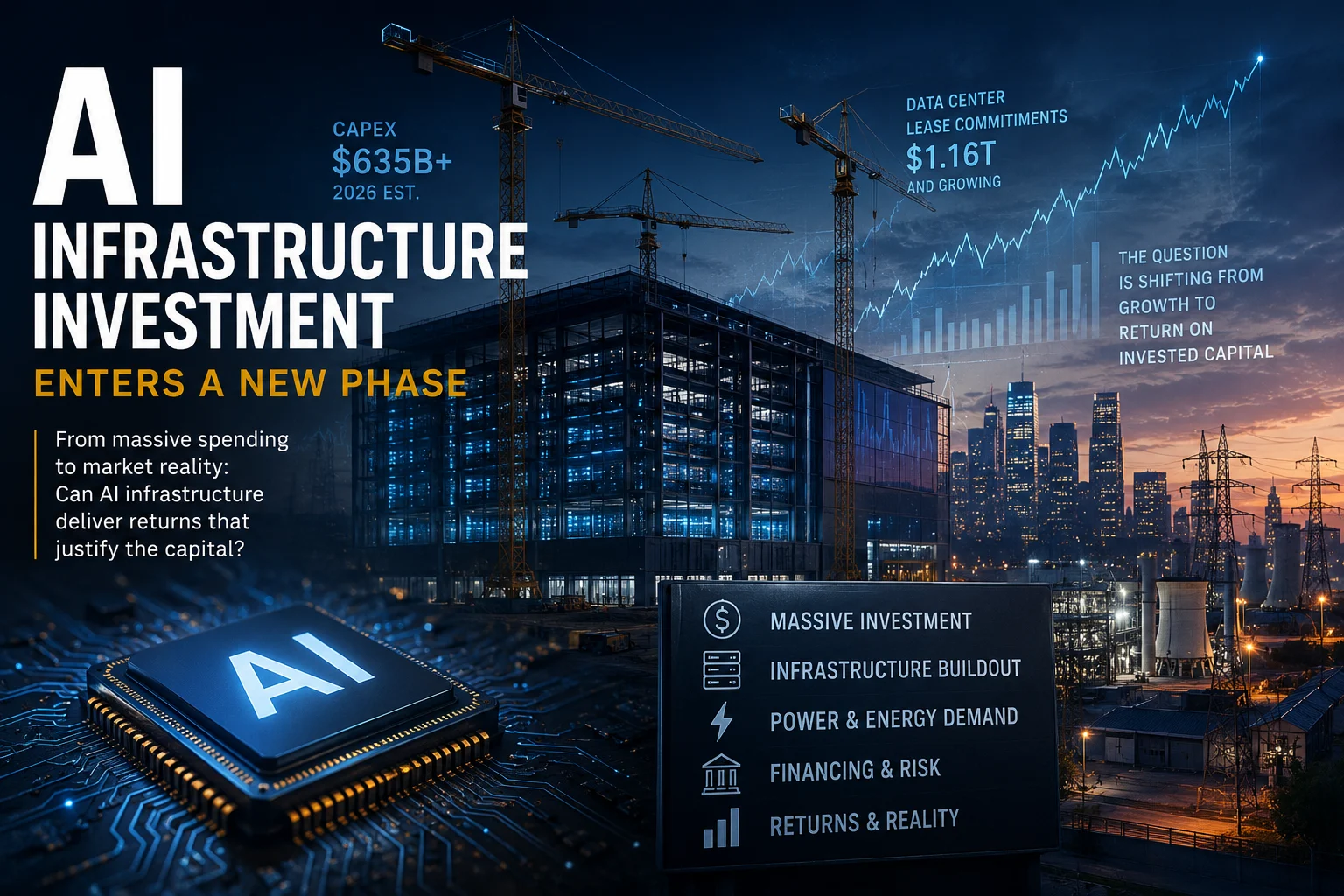
The question is shifting from whether companies want more compute to how all of that compute will be financed, who will ultimately carry the balance-sheet risk, how much utilization these assets can sustain, and whether future AI revenue will justify the enormous commitments already being made today.
That shift matters because markets rarely become uncomfortable when companies are investing aggressively during a boom.
They become uncomfortable when the cost of maintaining the boom starts rising faster than confidence in the returns.
And AI may be approaching exactly that stage.
The AI Trade Is Moving Down the Capital Stack
Investors initially experienced the AI boom through the most obvious beneficiaries.
Semiconductor companies became the center of attention. Nvidia represented the clearest expression of the trade because its GPUs were essential to training and running increasingly complex models.
Then the market expanded outward.
Networking companies benefited.
Memory suppliers benefited.
Server manufacturers benefited.
Cloud providers became another layer of the opportunity.
Utilities, power producers, cooling-system companies, data-center developers, fiber operators, and infrastructure financiers gradually entered the conversation.
Now the capital itself is becoming part of the trade.
That is an important evolution.
When an investment cycle reaches sufficient scale, the companies supplying the technology are no longer the only businesses that matter. Financing structures begin to influence which projects get built, how quickly capacity expands, and how much risk gets distributed throughout the financial system.
AI infrastructure appears to be moving toward that stage.
Big technology companies have accumulated enormous commitments associated with future data-center capacity. Reuters calculated that known uncommenced lease commitments among five major technology companies had reached roughly $1.16 trillion after additional agreements announced by Meta.
A trillion-dollar pipeline changes the character of the conversation.
It is no longer enough to ask how many GPUs companies are buying.
The market also needs to ask who owns the facilities, who finances the equipment, who guarantees the leases, how long the contracts run, what happens when new hardware replaces older hardware, and whether pricing for compute remains strong enough to support the economics of the entire system.
These are capital-allocation questions.
And capital allocation is where technological enthusiasm eventually meets economic reality.
Compute Is Starting to Look Like an Asset Class
One of the most interesting developments in the AI economy is the transformation of compute from a technical resource into something that increasingly behaves like financial infrastructure.
Historically, computing hardware was treated primarily as equipment.
A company purchased servers. Those servers depreciated. Eventually they were replaced.
AI has changed the scale of that equation.
When clusters containing tens of thousands of expensive accelerators are housed inside facilities that require dedicated power, cooling, networking, land, and long-term energy agreements, compute starts looking less like ordinary IT equipment and more like industrial infrastructure.
That creates opportunities for an entirely different group of market participants.
Banks can finance it.
Private credit funds can lend against it.
Infrastructure investors can own the buildings.
Technology companies can lease the capacity.
Specialized cloud providers can rent it to AI developers.
Asset managers can structure investment vehicles around the cash flows.
The AI boom therefore has the potential to financialize compute in much the same way other infrastructure categories evolved.
But there is an important difference.
A toll road does not become technologically obsolete because a better road is released two years later.
A power plant does not suddenly lose most of its economic value because a new generation of turbines offers dramatically better performance.
AI hardware faces a much faster technology cycle.
That creates an unusual tension.
Investors are being asked to finance infrastructure with long-duration capital while some of the most valuable equipment inside that infrastructure may experience rapid technological depreciation.
That mismatch could become one of the defining financial questions of the AI investment cycle.
The Market Still Believes Demand Is Real
None of this means the AI infrastructure boom is automatically a bubble.
Current evidence continues to show substantial demand.
CoreWeave’s backlog is one example. Strong forecasts from infrastructure providers have also helped ease fears that hyperscaler spending is about to collapse. Super Micro’s recent outlook contributed to a rally across several AI infrastructure names, including CoreWeave, Nebius Group, Applied Digital, and IREN.
There is also a practical reason the spending continues.
The AI race has become strategic.
For Microsoft, Alphabet, Amazon, Meta, and other major technology companies, insufficient computing capacity may represent a larger competitive risk than temporary overinvestment.
That changes normal capital discipline.
Imagine two competing technology platforms.
One spends conservatively and maintains excellent free cash flow but lacks enough compute to deploy competitive AI products.
The other spends aggressively, accepts lower near-term cash generation, but gains enough infrastructure to train models faster, serve more customers, and integrate AI throughout its product ecosystem.
If AI becomes foundational to future software and internet services, the second company may ultimately be in the stronger position.
Management teams understand that possibility.
Investors understand it too.
This is one reason extraordinarily high capital expenditure has not automatically triggered a broad rejection of Big Tech stocks.
The market is willing to tolerate spending when investors believe the expenditure protects future competitive advantage.
The problem appears when that belief weakens.
Capex Is Becoming the Metric That Matters
For years, technology investors became accustomed to asset-light economics.
Software businesses could grow rapidly without building factories.
Cloud computing still required physical infrastructure, but the enormous operating leverage and recurring revenue made the economics compelling.
AI is pulling portions of the technology sector back toward a far more capital-intensive model.
Servers need to be purchased.
Data centers need to be constructed.
Power infrastructure needs upgrades.
Networking capacity needs expansion.
Land needs to be secured.
Cooling systems become more sophisticated.
And increasingly, companies are making commitments years before the infrastructure is actually operational.
That makes capital expenditure one of the most important numbers in the AI market.
The size alone is extraordinary.
Earlier in 2026, estimates indicated that Microsoft, Amazon, Alphabet, and Meta could collectively spend roughly $635 billion on data centers, chips, and related AI infrastructure during the year.
But the absolute number is less interesting than the relationship between spending and future cash flows.
An additional $10 billion of capital expenditure is easy to justify if it produces $20 billion of durable annual operating profit.
It becomes far less attractive if aggressive competition pushes compute pricing lower while hardware depreciation remains high.
This is why investors increasingly need to watch more than revenue growth.
The real scoreboard includes utilization, pricing power, depreciation, operating cash flow, financing costs, and returns on invested capital.
AI can continue growing rapidly while still becoming a worse investment for certain infrastructure owners.
Growth and investment returns are not the same thing.
That distinction is going to matter more as the cycle matures.
Free Cash Flow Is Where the Story Gets Interesting
One of the market’s biggest tests will come from free cash flow.
Companies can report impressive revenue growth while simultaneously consuming enormous amounts of cash.
Infrastructure cycles make that possible because spending often happens before revenue arrives.
Oracle provides an extreme example of how quickly the relationship can change. Its capital expenditure reached $55.7 billion in its 2026 fiscal year, while operating cash flow was about $32 billion. Reuters calculated that capex represented 174% of operating cash flow.
That does not necessarily mean the investment is bad.
It means investors are effectively being asked to finance future economics today.
The stronger the expected economics, the easier that request becomes.
The weaker the expected economics, the more uncomfortable the market becomes.
Large technology companies such as Microsoft, Alphabet, and Meta have so far remained capable of producing substantial cash while investing heavily, which gives them an advantage.
But even cash-rich companies cannot escape capital efficiency forever.
Eventually shareholders will ask a basic question:
What are we getting for every dollar being invested?
That question becomes particularly important if AI monetization develops more slowly than infrastructure spending.
The industry does not need AI demand to disappear for returns to disappoint.
It merely needs revenue growth to arrive later than expected while spending remains elevated.
The Most Important Risk May Be Overcapacity
Technology investment cycles have a habit of producing shortages first and excess capacity later.
The early phase is easy to understand.
Demand rises faster than supply.
Prices increase.
Companies rush to add capacity.
High margins attract new competitors.
Capital becomes available.
More projects are announced.
Eventually, supply catches up.
Sometimes it overshoots.
AI infrastructure could follow a similar pattern.
At the moment, the market is still primarily worried about not having enough compute.
But the construction decisions being made today will create capacity years into the future.
That means investors are effectively making assumptions about AI demand several technology generations ahead.
This creates a timing problem.
If demand continues accelerating, today’s aggressive investments may look conservative in hindsight.
If AI efficiency improves faster than expected, however, users may require less compute per task.
If models become cheaper to run, utilization assumptions could change.
If custom silicon gains market share, the economics of GPU-heavy infrastructure could shift.
If companies discover that some workloads can run locally rather than inside enormous centralized data centers, demand patterns could evolve again.
None of those outcomes requires AI to fail.
In fact, AI could become far more widely used while simultaneously becoming less expensive to operate.
That would be excellent for adoption.
It might be less attractive for companies whose valuations depend on persistent scarcity in compute.
This is a classic market paradox.
The technology can win while some investments built around the technology lose.
Investors Are Already Questioning the Spending Curve
The debate is not entirely theoretical.
Some investors have already started positioning for slower growth in hyperscaler capital expenditure.
UBS projections cited by Reuters suggested hyperscaler capex growth could fall from 76% in 2026 to only 6% by 2028. Some portfolio managers have consequently reduced semiconductor exposure and moved toward businesses that may benefit from AI adoption rather than directly financing the infrastructure buildout.
That distinction could become increasingly important.
The first stage of the AI market rewarded the companies selling the picks and shovels.
The next stage may reward businesses that use those tools to improve margins, productivity, or revenue.
Healthcare companies using AI to reduce administrative costs may benefit.
Cybersecurity businesses embedding AI into threat detection may benefit.
Financial institutions automating research and customer operations may benefit.
Industrial businesses improving logistics may benefit.
Software companies that generate more output with fewer employees may benefit.
In that environment, the market’s attention could gradually move from infrastructure providers toward AI users.
That does not mean infrastructure companies stop growing.
It means the valuation premium may migrate.
Markets care about where incremental returns are highest.
Once infrastructure becomes abundant, value often moves toward whoever can use that infrastructure most efficiently.
Power Is Becoming Part of the AI Valuation Model
There is another constraint investors cannot ignore: electricity.
AI infrastructure is unusual because technological progress is colliding directly with physical limitations.
A software company can scale an application globally with relatively little concern about local electricity generation.
A massive AI data center cannot.
It needs megawatts.
Sometimes hundreds of them.
The power must exist.
Transmission capacity must exist.
Grid connections must be available.
Permits must be obtained.
Cooling must work.
The physical environment therefore becomes part of what was previously considered a software investment thesis.
That is why utilities, natural gas producers, nuclear companies, grid-equipment manufacturers, and energy infrastructure providers have increasingly become indirect participants in the AI trade.
This is a classic second-order effect.
The first-order AI trade was chips.
The second-order trade was data centers.
The third-order trade may increasingly involve the physical systems required to keep those facilities operating.
Capital follows bottlenecks.
If chips stop being the primary constraint and electricity becomes the constraint, money will move accordingly.
That is exactly the kind of transition investors need to watch.
Financing Could Become the Next Competitive Advantage
The largest technology companies possess something that smaller AI businesses do not: enormous balance sheets.
That matters more as the industry becomes capital intensive.
A company capable of generating tens of billions of dollars in annual cash flow can fund infrastructure internally.
Smaller providers may need debt, leases, private credit, or strategic partners.
This creates very different risk profiles even when both companies participate in the same growth market.
The AI infrastructure race is therefore becoming partly a competition over cost of capital.
A company that can borrow cheaply can build capacity at a lower economic hurdle rate.
A business dependent on expensive financing needs higher future returns to justify the same project.
When capital is plentiful, that difference may appear small.
When financial conditions tighten, it becomes enormous.
This is another reason interest rates remain relevant to the AI story.
The technology may be revolutionary, but the infrastructure still exists inside a financial system.
Debt has a price.
Equity has a price.
Leases create obligations.
Assets depreciate.
And eventually capital providers expect to be paid.
AI does not suspend those rules.
It simply creates new assumptions about how large the eventual rewards could become.
The Market Is Entering a More Difficult Phase
Early investment cycles are often easier to trade.
Demand is obviously rising.
Supply is clearly constrained.
The beneficiaries are relatively easy to identify.
Later phases require more discrimination.
Some companies will own valuable assets.
Others may own expensive assets.
Those are not necessarily the same thing.
Some AI infrastructure providers will secure long-term contracts with high-quality customers and maintain strong utilization.
Others may build capacity based on demand forecasts that prove too optimistic.
Some financing structures will distribute risk efficiently.
Others may simply move risk away from the most visible corporate balance sheets.
Some hyperscalers will turn AI spending into new profit engines.
Others may discover that they have entered an arms race where every competitor must spend simply to protect existing market share.
Those differences are where Maxel believes the next phase of the AI market becomes more interesting.
The easy question was whether AI infrastructure would attract capital.
That has already been answered.
It has attracted extraordinary amounts of it.
The harder question is what that capital ultimately earns.
Watch the Returns, Not Just the Spending
Investors should therefore resist treating every new data-center announcement as automatically bullish.
More spending can signal stronger demand.
It can also signal stronger competition.
A rising backlog can demonstrate visibility.
It can also create future execution obligations.
Long-term leases can secure capacity.
They can also lock companies into expensive commitments.
Debt financing can accelerate growth.
It can also magnify mistakes.
The market will increasingly need to distinguish between these possibilities.
Several indicators deserve particular attention over the next few years.
First is utilization.
New infrastructure needs customers.
Facilities operating far below capacity will struggle to produce attractive returns regardless of how impressive they look on paper.
Second is compute pricing.
Persistent scarcity supports margins.
Rapid commoditization does the opposite.
Third is depreciation.
The faster hardware becomes economically obsolete, the harder it becomes to finance that hardware as a long-duration asset.
Fourth is free cash flow.
Eventually the AI boom needs to produce cash, not merely revenue.
Fifth is the direction of capital.
If investors begin shifting money away from infrastructure suppliers toward businesses applying AI productively, it could signal that the market believes the buildout is entering a more mature phase.
And finally, watch financing.
The moment an investment boom becomes dependent on increasingly creative structures to maintain its pace, capital-market risk becomes just as important as technological risk.
AI’s Next Market Story Will Be About Economics
Artificial intelligence remains one of the most powerful investment themes of this decade.
Nothing about the current infrastructure boom suggests that companies have suddenly lost interest in computing capacity.
If anything, recent forecasts show that demand remains strong enough to surprise investors.
But strong demand does not remove the need for discipline.
The AI market is growing up.
Its first chapter was dominated by technological possibility.
Its second was dominated by infrastructure scarcity.
The next chapter may be dominated by economics.
Who owns the assets?
Who finances them?
Who carries the depreciation risk?
Who has pricing power?
Who can generate enough revenue to justify the capital?
And perhaps most importantly, where does the highest return on the next dollar of AI investment actually sit?
These questions will not produce a single winner.
They will divide the AI trade into companies that merely participate in the boom and companies that successfully turn the boom into durable returns.
That distinction matters because markets do not ultimately reward spending.
They reward productive capital.
The AI infrastructure race has already proven that companies are willing to spend at historic scale.
Now comes the more difficult test.
They have to prove the investment was worth it.