
S&P 500 Volatility Rises Amid Middle East Tensions
 Vortixel
8 minutes read
Vortixel
8 minutes read
Introduction: A Market Caught Between Fear and Opportunity
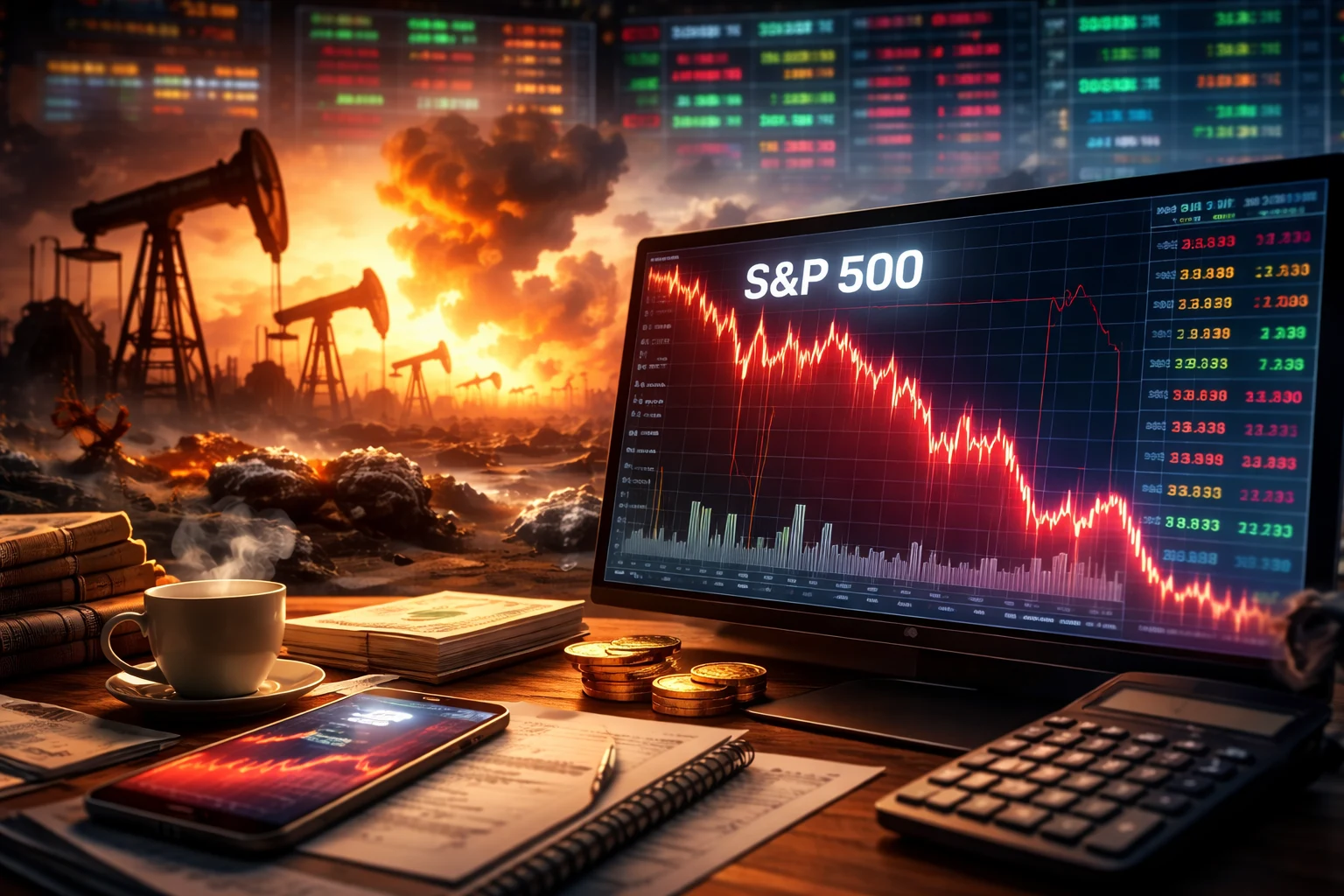
The S&P 500 volatility in April 2026 has become one of the most talked-about topics across global financial markets, and not without reason. Investors who entered the year expecting a relatively stable macroeconomic environment are now facing a completely different reality shaped by escalating geopolitical tensions in the Middle East. The sudden surge in oil prices, rising inflation fears, and uncertainty around global supply chains have all converged to create a fragile market atmosphere where every headline can trigger massive price swings. This is not just another short-term fluctuation, but a deeper structural shift that is forcing investors, institutions, and policymakers to rethink their strategies in real time.
Over the past few weeks, the S&P 500 index has experienced sharp intraday swings, with gains quickly erased by negative geopolitical updates. The market is no longer reacting purely to economic data like employment or earnings reports, but instead to geopolitical risk signals that are far harder to predict. This has created a highly reactive environment where sentiment changes faster than fundamentals, making it increasingly difficult for traders to maintain conviction in their positions. For Gen Z investors and younger market participants, this is a defining moment that highlights how interconnected global events can directly influence financial markets.
Understanding the Trigger: Middle East Tensions and Oil Shock
At the center of the current market instability is the escalating conflict in the Middle East, particularly involving key oil-producing regions. The potential disruption of supply routes, especially around critical chokepoints like the Strait of Hormuz, has sent shockwaves through the energy markets. As oil prices surged past the $110 per barrel mark, the ripple effects quickly spread across global equities, commodities, and currencies. Energy markets are often the first to react to geopolitical tensions, but in this case, the impact has been amplified due to already tight supply conditions.
The rise in oil prices is not just a standalone issue, but a catalyst that influences multiple layers of the global economy. Higher energy costs translate into increased production expenses for businesses, which in turn puts upward pressure on consumer prices. This creates a renewed fear of inflation at a time when central banks were just beginning to regain control over price stability. As a result, the S&P 500 volatility is being driven not only by geopolitical uncertainty but also by macroeconomic implications that extend far beyond the energy sector.
Market Reaction: Why the S&P 500 Is So Sensitive Right Now
The current behavior of the S&P 500 index reflects a market that is highly sensitive to risk. Unlike previous years where strong corporate earnings could offset external shocks, today’s market is operating under tighter financial conditions. Interest rates remain elevated, liquidity is more constrained, and valuations in certain sectors are still relatively high. This combination creates a scenario where even minor negative developments can trigger outsized reactions.
One of the key reasons behind the heightened S&P 500 volatility is the dominance of algorithmic trading and short-term positioning. In a market driven by rapid information flow, automated systems can amplify price movements by reacting instantly to news headlines. This leads to a feedback loop where volatility feeds on itself, making it harder for long-term investors to navigate the noise. Additionally, the growing influence of retail investors, many of whom are highly active on social media platforms, has added another layer of unpredictability to market dynamics.
Sector Breakdown: Winners and Losers in a Volatile Market
Not all sectors within the S&P 500 are reacting in the same way to the current environment. Energy stocks have emerged as clear winners, benefiting directly from rising oil prices and increased demand for fossil fuels. Companies involved in oil exploration, production, and refining are seeing significant gains as investors rotate into sectors that can hedge against inflation and geopolitical risk. This has created a divergence within the index, where gains in energy are offsetting losses in other areas.
On the other hand, technology stocks, which have been the backbone of the market’s growth over the past decade, are facing renewed pressure. Higher interest rates reduce the present value of future earnings, making high-growth tech companies less attractive in the current environment. Additionally, supply chain disruptions and increased costs are further weighing on the sector. Consumer discretionary stocks are also under pressure as higher energy prices reduce disposable income, leading to concerns about slowing demand.
Financial stocks present a mixed picture, as higher interest rates can benefit banks through improved net interest margins, but increased market volatility and economic uncertainty can also lead to higher risk exposure. This complex interplay of factors highlights the importance of sector rotation in navigating the current market landscape.
Investor Psychology: Fear, Uncertainty, and Overreaction
One of the most important aspects of the current S&P 500 volatility is the role of investor psychology. Markets are not driven solely by data and fundamentals, but also by emotions and perception. In times of uncertainty, fear tends to dominate, leading to risk-off behavior where investors move capital into safer assets such as gold, government bonds, or cash. This shift can exacerbate market declines, creating a self-reinforcing cycle of selling pressure.
At the same time, periods of high volatility often create opportunities for contrarian investors who are willing to take on risk when others are fearful. This dynamic creates a tug-of-war between panic selling and opportunistic buying, resulting in sharp price swings that can occur within a single trading session. For younger investors who have grown up in a digital-first world, the speed at which information spreads can intensify emotional reactions, making it even more challenging to maintain a long-term perspective.
Global Impact: Beyond the U.S. Stock Market
The effects of Middle East tensions are not limited to the S&P 500, but extend across global markets. European and Asian indices have also experienced increased volatility, reflecting the interconnected nature of the global economy. Countries that are heavily dependent on energy imports are particularly vulnerable, as rising oil prices can lead to higher inflation and weaker economic growth.
Emerging markets face an even more complex situation, as they must deal with both external shocks and internal challenges. Currency depreciation, capital outflows, and rising debt costs are all potential risks that can be exacerbated by global instability. This highlights the importance of understanding the broader context in which the S&P 500 volatility is occurring, as it is part of a larger global trend rather than an isolated event.
Central Banks and Policy Response
Central banks are now facing a difficult balancing act as they navigate the implications of rising geopolitical risk and inflation. On one hand, they need to maintain price stability by keeping interest rates at levels that can control inflation. On the other hand, overly aggressive tightening could further slow economic growth and increase the risk of recession. This creates a policy dilemma that adds another layer of uncertainty to the market.
The Federal Reserve, in particular, is under close scrutiny as investors try to anticipate its next moves. Any संकेत of a shift in policy, whether towards easing or further tightening, can have a significant impact on the S&P 500 index. This makes central bank communication a critical factor in shaping market expectations and influencing investor behavior.
Short-Term Outlook: What Traders Should Watch
In the short term, the direction of the S&P 500 volatility will largely depend on developments in the Middle East and the trajectory of oil prices. Key factors to watch include any escalation or de-escalation of conflict, changes in energy supply, and updates from major oil-producing nations. Additionally, upcoming economic data releases and corporate earnings reports will provide further insights into how businesses are coping with the current environment.
Technical indicators also play a role in shaping market movements, as traders look for support and resistance levels to guide their decisions. However, in a highly volatile market, technical analysis can be less reliable, as unexpected news can quickly override established patterns. This makes risk management more important than ever for traders who are navigating short-term opportunities.
Long-Term Perspective: Is This a Structural Shift?
While the current S&P 500 volatility is being driven by immediate geopolitical factors, it also raises questions about the long-term direction of the market. The increasing frequency of global disruptions, whether due to geopolitical conflicts, pandemics, or climate-related events, suggests that volatility may become a more permanent feature of financial markets. This has implications for how investors approach portfolio construction and risk management.
Diversification, once considered a basic principle, is now more critical than ever in managing uncertainty. Investors may need to consider a broader range of asset classes, including commodities, alternative investments, and international exposure, to mitigate risk. Additionally, the role of technology and data analytics in investment decision-making is likely to continue growing, as investors seek to gain an edge in an increasingly complex environment.
Conclusion: Navigating Volatility in a New Market Era
The recent surge in S&P 500 volatility driven by Middle East tensions is a stark reminder of how quickly market conditions can change. What began as a localized geopolitical issue has evolved into a global financial concern with far-reaching implications. For investors, the key takeaway is the importance of adaptability and resilience in the face of uncertainty. Markets will always experience periods of volatility, but those who are able to stay informed, manage risk, and maintain a long-term perspective are more likely to navigate these challenges successfully.
As we move further into 2026, the interplay between geopolitics, economics, and market dynamics will continue to shape the investment landscape. The S&P 500 index may remain volatile in the near term, but it also presents opportunities for those who are prepared to look beyond the noise and focus on the bigger picture. In this new era of global interconnectedness, understanding the forces driving market movements is not just an advantage, but a necessity.